


RSI Hermes Q&A: Everything You Need to Know About Star Citizen's New Blockade Runner
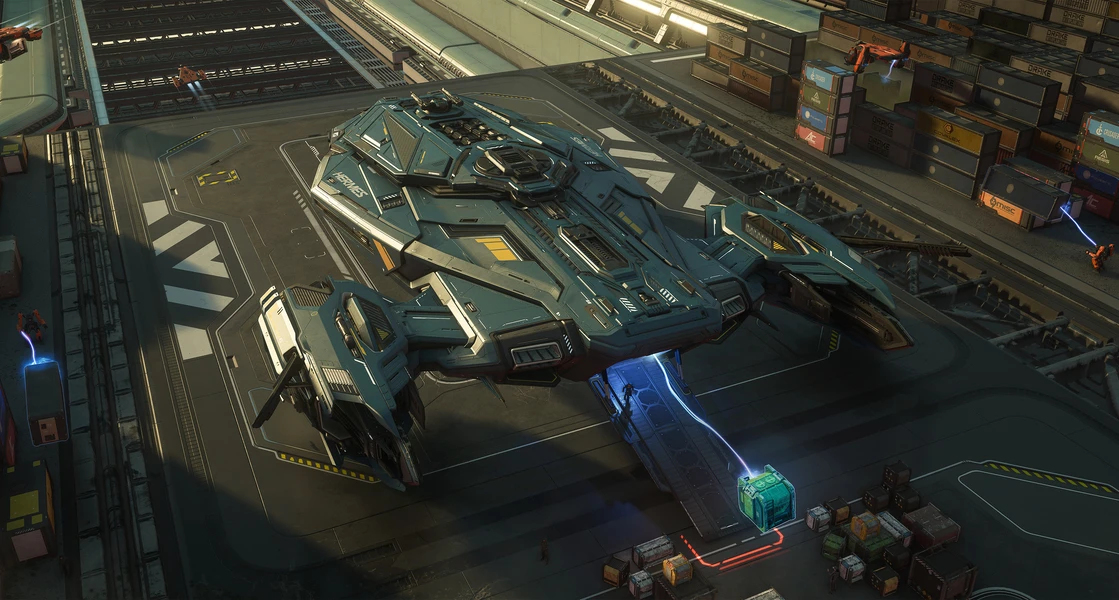


Roberts Space Industries has unveiled comprehensive details about the Hermes, their latest medium freight hauler designed to redefine cargo operations in Star Citizen's increasingly dangerous universe. Described as a blockade runner with substantial capacity and impressive speed, the Hermes represents RSI's answer to the growing demand for vessels capable of delivering cargo to hostile territories.
The Blockade Runner Concept
The term "blockade runner" has been associated with the Hermes throughout its development, and the Vehicle and Gameplay teams have clarified exactly what this designation means. A blockade runner is specifically designed to circumvent enemy forces surrounding ports or heavily defended locations. The Hermes embodies this role through its combination of substantial cargo capacity, powerful main thrusters, and enhanced hull health and armor. These characteristics make it particularly well-suited for transporting valuable payloads through dangerous space lanes where other haulers might struggle.
Cargo Capacity and Market Position
With 288 SCU of internal cargo capacity, the Hermes positions itself uniquely within the medium freight category. Unlike competitors such as the Argo RAFT and MISC Hull B, which store cargo externally, the Hermes keeps all cargo protected within its hull. This internal storage provides significant advantages in terms of protection and operational flexibility. When compared to other internal cargo haulers like the RSI Constellation Taurus and MISC Starlancer MAX, the Hermes offers considerably more capacity despite having a shorter physical profile.
The cargo hold is designed around 32 SCU containers, representing the maximum container size that can be loaded and stored inside the vessel. This versatility extends to accepting any standard cargo crate size from 1 SCU up to the maximum 32 SCU, allowing operators to accept a diverse range of hauling contracts. The spacious cargo bay can also accommodate non-standardized cargo, including vehicles and mission-specific items like Valakkar fangs that prove awkward to transport in other vessels.
Performance Characteristics
The development team has provided detailed comparisons between the Hermes and its sibling, the Apollo medical ship. The Hermes benefits from additional hull health compared to the Apollo, along with higher speeds in both Space Combat Maneuvering (SCM) and Navigation (NAV) modes. These improvements come with a trade-off in acceleration, as the Hermes sacrifices some responsiveness for its enhanced durability and top speed.
Maneuverability has been improved compared to the Apollo Triage variant, facilitating easier navigation around stations and landing zones. While the Hermes shares design DNA with the Apollo line, it represents a separate chassis rather than a variant, meaning paints and customization options are not interchangeable between the two ship families.
Cargo Bay Design Philosophy
The cargo hold's distinctive short and wide configuration emerged from specific design considerations. The development team prioritized maintaining standard SCU volume metrics rather than maximizing every available cubic meter of space. This decision reflects player feedback regarding older ships with taller cargo grids, which many found challenging to manage efficiently. The Hermes avoids these issues by keeping the cargo bay dimensions practical and user-friendly.
Even when fully loaded with secured cargo, the Hermes maintains clear access to ship components for engineering gameplay. The central floorspace in the main cargo grid remains accessible, ensuring crew members can reach critical systems without difficulty. Players do have the option to place additional unsecured cargo in these walkways, though this comes at the cost of impeded movement throughout the ship.
Vehicle Transport Capabilities
Beyond standard cargo containers, the Hermes can accommodate ground vehicles through its rear ramp. Most vehicles up to and including the Tumbril Cyclone series can fit through the entrance and be parked within the cargo bay. This flexibility adds another dimension to the ship's utility, allowing operators to transport exploration vehicles, racing craft, or combat-ready ground assets alongside traditional cargo.
Tractor Beam System
The Hermes features an innovative tractor beam mounted on a rail system, similar to the Scorpius' turret mechanism. This system allows the beam to move between two dedicated positions, providing coverage across the cargo bay. The tractor beam can be operated from either the co-pilot seat or a dedicated station located in the rear of the ship.
For solo operators, the workflow involves landing the ship from the pilot seat, then moving to one of the tractor beam control positions to manage cargo loading and unloading. While this process is entirely manageable for a single player, having a second crew member significantly streamlines operations. The ship's design emphasizes this balance between solo capability and multi-crew efficiency.
Fleet Integration
The Hermes serves multiple roles within both individual and organizational fleets. Solo players can leverage its capacity for lucrative hauling missions, while groups can integrate it into larger logistics operations. The ability to transport diverse cargo types, from standardized containers to vehicles and specialized mission items, makes it a versatile asset for various gameplay scenarios.
Combat Capabilities
While the Hermes is not designed as a dogfighter, it can defend itself when necessary. The ship mounts four Size 4 weapons, with two controlled by the pilot and two mounted on a remote turret that can optionally be slaved to pilot control. This armament provides meaningful deterrence against would-be pirates, particularly when combined with the ship's enhanced hull strength and armor. Any hostile vessel positioned in front of the Hermes must contend with substantial firepower, even if the hauler's maneuverability prevents it from excelling in prolonged combat engagements.
Development Considerations
The development team has emphasized that all specifications and features reflect current intentions and remain subject to refinement. As with all Star Citizen ships in development, the final implementation may evolve based on playtesting feedback, balance considerations, and overall game quality improvements. This iterative approach ensures the Hermes will integrate smoothly into the game's expanding economy and combat systems.
The RSI Hermes represents an ambitious addition to Star Citizen's medium freight category, combining substantial cargo capacity with the speed and durability needed for operations in contested space. Whether running blockades in Pyro or conducting routine hauling operations in safer systems, the Hermes offers capabilities that should appeal to cargo haulers seeking a robust, versatile platform for their operations.
When the Blockade Breaks
The comm channel crackled to life with familiar voices as Commander Zara "Zenith" Chen brought her RSI Hermes into formation with the rest of the 30KFUN convoy.
"Alright folks, listen up," she announced, watching her scanner display six friendly signatures. "We've got a simple milk run today—288 SCU of medical supplies from Port Olisar to Pyro Station. Should be easy money."
"Famous last words," chuckled Marcus "Mentor" Rodriguez from his Drake Corsair. "Remember when you said that about the Hurston run?"
"Hey, how was I supposed to know the server would 30K right as we were landing?"
"Because it's Star Citizen," came the chorus of responses, followed by laughter across the channel.
The convoy consisted of veterans and newbies alike—exactly how 30KFUN preferred it. Today's newest member, a pilot named Kai flying a rented Aurora, had joined just three days ago. Mentor had already spent two hours walking him through the basics, and now it was time for his first real cargo run.
"Kai, you still with us?" Zenith asked.
"Right here! Just... uh... trying to remember which button activates quantum drive."
"'B' key, buddy," Mentor responded patiently. "And remember, if you get stuck in your ship geometry, just backspace and respawn. It happens to everyone."
"Even to Zenith," added pilot Sarah "Snapshot" Kim from her Cutlass Black.
"Especially to Zenith," Zenith corrected with a grin.
The jump to Pyro went smoothly—too smoothly. As they dropped out of quantum near the jump point, Zenith's threat detector screamed to life. Three Cutlass Blacks bearing pirate markings emerged from behind an asteroid cluster, blocking their path to the jump point.
"Well, this just got interesting," Zenith muttered, her hands moving to her weapon controls. The Hermes' four Size 4 weapons powered up, their targeting systems painting the nearest hostile.
"New guy, listen carefully," Mentor's voice cut through the sudden tension. "Quantum to the coordinates I'm sending you now. Don't be a hero—we need you alive, not brave."
"But I can help—"
"Negative. This is your first combat situation. Follow the plan. We've got this."
Kai's Aurora vanished in a flash of quantum light just as the pirates opened fire. The 30KFUN veterans immediately shifted into a defensive formation around Zenith's Hermes, their practiced coordination evident despite the game's notoriously unpredictable netcode.
"Snapshot, take the left flank!" Zenith called out, her Hermes' forward guns lighting up the void. The blockade runner wasn't built for dogfighting, but its enhanced armor shrugged off the initial barrage. "Mentor, I need you on that Cutlass trying to flank—"
Her sentence cut off as her ship suddenly stopped responding. The dreaded red text appeared in the corner of her vision: "Connection to server lost."
"No, no, no—not now!" She watched helplessly as her screen froze, her Hermes suspended in the middle of the firefight.
"Zenith's 30K'd!" Snapshot announced. "Covering her position!"
The remaining 30KFUN pilots immediately adjusted, forming a protective sphere around Zenith's now-drifting ship. In most organizations, this would be chaos. But 30KFUN had faced the infamous 30K disconnect error so many times they'd practically written a guide about it.
"She'll be back in two minutes," Mentor said calmly, his Corsair's guns tracking a pirate attempting to close on the vulnerable Hermes. "Standard reconnect protocol. Keep them off her."
True to prediction, ninety seconds later, Zenith's Hermes flickered back to life as she reconnected to the server.
"Miss me?" she asked, immediately resuming fire on the nearest pirate.
"Like a 30K error," Snapshot quipped.
The pirates, expecting easy prey, hadn't counted on the 30KFUN community's coordination. Mentor's Corsair had already stripped the shields from one Cutlass, while Snapshot's precise gunnery had disabled another's engines. Zenith's Hermes, now back in action, added its substantial firepower to the mix.
"They're breaking off!" Kai's excited voice crackled over comms from his safe position several thousand kilometers away. "You did it!"
"We did it," Zenith corrected. "You followed orders, which is exactly what we needed. Good job, newbie."
The convoy regrouped and made the jump to Pyro. As they approached Pyro Station, Zenith activated her Hermes' unique rail-mounted tractor beam system, preparing for the unloading process.
"Kai, come on over and watch this," she offered. "I'll show you how the tractor beam works. Fair warning—it's probably going to glitch at least once."
"Why do you sound so cheerful about that?" Kai asked, bringing his Aurora alongside the Hermes.
"Because that's Star Citizen, kid," Mentor answered. "The bugs are half the fun. Wait until you see someone get launched into orbit by a cargo elevator."
"Happened to me last week," Snapshot added. "Made it all the way to Crusader before I stopped. Pretty sure I broke the speed record."
As predicted, the tractor beam did glitch—twice—causing a cargo container to spin wildly before Zenith managed to wrestle it into position. The whole convoy watched and offered increasingly unhelpful advice until she finally secured it.
"And that's how you load cargo," Zenith announced triumphantly. "Style points count for nothing, but we got it done."
The payment cleared, and the 30KFUN pilots gathered their ships in a loose formation outside the station.
"Same time next week?" Snapshot asked.
"Absolutely," Zenith confirmed. "Kai, you did great for your first real run. Next time, we'll teach you some combat basics."
"I can't wait! Though... does it always involve disconnecting mid-battle?"
"Only about half the time," Mentor laughed. "The other half, you clip through your ship's floor and die to falling damage in space."
"He's not joking," Zenith added. "I've got video evidence."
"Which I've documented in our bug report guide," Snapshot chimed in. "Screen-reader friendly, naturally. Because if we're going to crash, we're going to crash accessibly."
As the convoy dispersed, Kai found himself smiling. He'd joined 30KFUN expecting to learn Star Citizen. What he'd found was something better—a community that turned bugs into jokes, disconnects into stories, and strangers into friends.
"Hey Zenith?" he called over the comm. "Thanks for not leaving me behind."
"That's not how we do things here, Kai. In 30KFUN, we fly together, crash together, and respawn together. That's what makes it fun."
"Even when the server kicks you?"
"Especially when the server kicks you. Now let's get back to Olisar before the next 30K hits. I give it ten minutes."
"I'll take that bet," Mentor said. "I say five."
It was seven minutes. They all laughed as they reconnected, already planning their next adventure.
That was the 30KFUN way.
Another Star Citizen Fan Fiction from 30KFUN Accessible Gaming Community!
| ← Previous Article | Next Article → |
|---|---|
| Alpha 4.6: Lifeline for Levski - Save Stanton Initiative ... | Star Citizen Roadmap Update: Aurora Gold Standard, New Mi... |